Friday, 28 June 2013

Shoaib Malik

Shoaib Malik Biography

Source(google.com.pk)

Shoaib Malik (born 1 February 1982 in Sialkot) is a Pakistan cricketer. He made his One-Day International debut in 1999 against the West Indies and his Test debut in 2001 against Bangladesh. He started his career as just an off spinner, and is now regarded as a useful bowling all-rounder with a batting average in the mid 30s in both Test and ODI cricket. Malik is regarded as a flexible player. He is capable of hitting big shots but is also capable of rotating the strike with good placement. He has a strike rate of 77.23 runs per 100 balls, which compares favourably to players such as Rahul Dravid and Inzamam ul-Haq. His most brazen display of \”power hitting\” came in 2003 against South Africa when he scored 82 from 41 balls. As is required of most modern players he also has displayed good defensive batting at times. He has taken over 100 ODI wickets at an average under 35 and economy rate below 4.5. His bowling action has come under scrutiny (particularly his doosra) but he has had elbow surgery to correct this. In Tests, he has a better batting average against Sri Lanka and South Africa than other nations. In ODIs he has a better batting average against India, South Africa, and the West Indies than his overall career average. During his Test career, Malik has batted at 5 different positions and he has the unusual record of batting at every position except 11th in ODIs. Pakistan’s problems in finding a reliable opening pair have led to Malik being used as an opener in Test and ODI matches.
Shoaib Malik (Urdu: شعیب ملک‎) (born 1 February 1982) is a Pakistani cricket player and former captain. He made his One-Day International debut in 1999 against the West Indies and his Test debut in 2001 against Bangladesh. He has taken over 100 ODI wickets, and has a batting average in the mid 30s in both Test and ODI cricket. His bowling action has come under scrutiny (particularly his doosra) but he has had elbow surgery to correct this. Malik was ranked second, behind teammate Shahid Afridi, in the ICC ODI all-rounder rankings in June 2008.[1] In March 2010, Malik received a one-year ban from international cricket from the Pakistan Cricket Board (PCB); the ban was overturned two months later.[2]
Contents  [hide]
1 Early career
2 Pakistan captaincy
3 Post-captaincy
4 Playing style
4.1 Domestic Cricket
5 Personal life
6 Test centuries
7 ODI centuries
8 References
9 External links
Early career[edit]

Shoaib Malik first played tape-ball cricket in the streets as a child. He began to take playing cricket seriously in 1993/94 when he attended Imran Khan's coaching clinics in Sialkot. He began as a batsman only developing on his bowling later. He used to get in trouble with his family for playing cricket, as they wanted him to focus on his education. In 1996, Malik attended trials for the U-15 World Cup. He was selected in the squad for his bowling.[3]
In May 2001, Malik's bowling action was inspected. The PCB group of bowling advisers concluded that his stock off-spinner was legal, although his delivery going the other way was not. He was encouraged to concentrate on his off-spin and to practice bowling his other delivery without bending his arm.[4] In a One Day International (ODI) against England in June 2001, Malik suffered a fractured right shoulder after falling awkwardly while attempting to take a catch.[5]
Malik was approached by Gloucestershire County Cricket Club in July 2003 to act as a replacement for Ian Harvey, who was on international duty with Australia. John Bracewell, the club's director of cricket, commented that he was "excited by the prospect of signing an international spinning all-rounder to replace Ian during the Cheltenham Festival and the C&G semi-finals. He will add a new and refreshing dimension to the squad ... which is in keeping with our playing philosophy to both win and entertain".[6] He sufficiently impressed in two County Championship and three one-day matches that resulted in renewing of his contract for the 2004 season. Mark Alleyne, the club's head coach, remarked that "Shoaib did very well for us last year in the short time he was with us and fitted in very well. He is a gifted all-rounder who is worthy of a place in either discipline and as a 21-year old, he can only get better and I am really pleased at having him in my squad".[7] Over the course of his two seasons at Gloucestershire, Malik played eight first-class matches, scoring 214 runs at an average of 17.83 with two fifties[8] and taking 15 wickets at an average of 45.06, with best bowling figures of 3/76.[9] He also played twelve one-day matches, scoring 345 runs at an average of 43.12 with three fifties[10] and taking 10 wickets at an average of 47.60, with best bowling figures of 3/28.[11]
In October 2004, Malik was reported to the International Cricket Council (ICC) for having a "potentially flawed bowling action";[12] eight months later, his action was cleared.[13] In the intervening period, Malik was used mainly as a batsman.[14] He was also given a one-Test ban by the Pakistan Cricket Board after admitting to deliberately losing a Twenty20 match for the Sialkot Stallions against Karachi Zebras to knock Lahore Eagles out of the 2004–05 ABN-AMRO Twenty-20 Cup. The inquiry concluded that the incident "damaged Pakistan's cricketing image and had shown disrespect to the crowd", but that "his actions were not part of any match-fixing with no financial implications, but were an immature attempt to express his disappointment at earlier decisions in the competition that he felt went against his side".[15]
During his Test career, Malik has batted at 5 different positions and has the unusual record of batting at every position except 11th in ODIs. Pakistan's problems in finding a reliable opening pair have led to Malik being used as an opener in Test and ODI matches. In Test cricket, he made a big impression with his match-saving innings against Sri Lanka in 2006, during which he batted for the whole day and finished with 148 runs not out. His bowling has been effective at times, especially in one-day cricket where his best bowling figures are four wickets for 19 runs (4/19) in addition to many 3-wicket hauls.
On the international stage Malik struggled in England. In 12 ODIs across four tours between 2001 and 2006 he scored 98 runs at an average of 8.16, with just two scores above 20, far below his career ODI average of 34.35. Of people who have played at least eight ODIs in England, Malik's is the furthest below his overall average.[16]
Pakistan captaincy[edit]

Following Inzamam-ul-Haq's resignation as Pakistan captain after the 2007 World Cup, Malik was put forward as one of the names for the captaincy along with Younis Khan and Mohammad Yousuf. After Younis Khan's rejection, Malik was the popular choice as a younger player and was seen to represent a fresh start after the Inzamam era.
Pakistan's coach, Bob Woolmer, was a strong advocate of Malik's case to become captain; in Woolmer's opinion Malik was "the sharpest tactical tack among his group ... a real presence on the field".[17] Former skipper Imran Khan also backed Malik for the role, stating "He appears to have a good cricket brain and could turn out to be a very good choice for Pakistan cricket".[18] Malik was appointed captain on 19 April 2007 by the Pakistan Cricket Board (PCB), his experience considering his relatively young age and consistent performances were cited as other reasons for his appointment.[18] At the age of just 25, he was Pakistan's fourth youngest captain.[17]
In Malik's first series as captain, Pakistan defeated Sri Lanka 2–1 in an ODI series in Abu Dhabi. His next assignments were home Test and ODI series against South Africa, which Pakistan lost 1–0 and 3–2 respectively. 3–2 was the score in favour of India when Pakistan subsequently played an ODI series against their arch-rivals. Malik hit 89 and took three wickets in the final match, which Pakistan won by 31 runs.
Malik's captaincy lasted two years. A report by the coach and manager criticised his leadership, claiming that Malik was "a loner, aloof and involved in his own little world, which is OK but not when the team required a fully committed captain  We do not see any meaningful communication between players and captain other than his five-minute talk during the team meeting".[17] Younis Khan took over as captain on 27 January 2009[19] after a poor performance against Sri Lanka saw Malik step down.[19] In his two-year tenure as captain, Malik lead his country in two Tests, losing two and drawing one,[20] and 36 ODIs, of which Pakistan won 24,[21] and 17 T20Is, winning 12.[22]
Post-captaincy[edit]

In March 2010, Shoaib Malik was given a one-year ban from the national team by the PCB, who charged him with causing infighting within the team. It was part of a dramatic cull of players after Pakistan's winless tour of Australia, resulting in the fining or banning of seven players.[23] Two months later Lancashire County Cricket Club approached Malik to play for them during Twenty20 Cup. He agreed, saying "When Lancashire approached me to come and play for them I didn't hesitate in saying yes. I love playing cricket in England and the opportunity to play with a club of Lancashire's reputation was too good to pass up".[18] On 29 May 2010, Malik's ban was overturned and his Rs 2 million fine halved.[2] He was subsequently named in the 2010 Asia Cup squad,[24] and as a result, Malik pulled out of his contract with Lancashire.[25] Pakistan did not make the final of the four-team tournament,[26] and Malik played in two matches, amassing 47 runs.[27] Mailk was in Pakistan's squad to play Australia and England in England in June–August 2010, but was dropped from the side. A regular in the ODI side, over the previously 12 months he had averaged around 30 with the bat in ODIs, and excluding one score over 50, his batting average hovered around 20. Mohsin Khan, Pakistan's chairman of selectors, cited Malik's poor recent form as the reason for dropping him.[28]
Playing style[edit]

According to Cricinfo's Osman Samiuddin:[29]
(Malik’s) batting repertoire doesn't burst forth with strokes; there remains a distinctly utilitarian appeal to it. His drives straight are generally checked, dispossessed of flourish and in his forward defensive prods, there is an exaggerated care, just to make fully sure. It doesn't mean elegance doesn't come to him, as a couple of cover drives off Anil Kumble and Harbhajan Singh to bring Pakistan nearer its hundred showed. Midwicket slogging also comes naturally to him, usually more effective than beautiful.
—Osman Samiuddin, 2006
Malik is regarded as a flexible player. He is capable of hitting big shots but is also capable of rotating the strike with good placement. He has a strike rate of 77.23 runs per 100 balls, which compares favourably to players such as Rahul Dravid and Inzamam ul-Haq. His most brazen display of "power hitting" came in 2003 against South Africa when he scored 82 from 41 balls. As is required of most modern players, he also has displayed good defensive batting at times.
Domestic Cricket[edit]
Shoaib Malik is captain of the Sialkot Stallions. He has led them to a record 7 domestic T20 titles with the most recent coming on 1 April 2012.[30]
Personal life[edit]

In 2008, media reports in Pakistan surfaced that Malik has married Ayesha Siddiqui, a woman from Hyderabad, India, on 3 June 2002. Malik denied these allegations saying his marriage plans with the woman did not go through, because of a lack of consensus between both the families.[31] In April 2010, Siddiqui's family released Shoaib-Ayesha 'marriage' certificate (Nikahnama).[32] On 2 April 2010, Malik said he plans to sue Siddiqui's family for "indulging in character assassination".[33][34][35] On 7 April 2010 Malik confirmed his marriage with Siddiqui and signed the Talaq (divorce) papers.[36]
On 12 April 2010, Malik married Indian tennis player Sania Mirza[37] in an Islamic wedding ceremony at the Taj Krishna Hotel in Hyderabad, India followed by Pakistani wedding customs[38][39] for a mahr of 61 lakh (US$137,500). Their Walima ceremony was held in Lahore, Pakistan.[40]

Shoaib Malik

Shoaib Malik

Shoaib Malik

Shoaib Malik

Shoaib Malik

Shoaib Malik

Shoaib Malik

Shoaib Malik

Shoaib Malik

Shoaib Malik

Shoaib Malik 

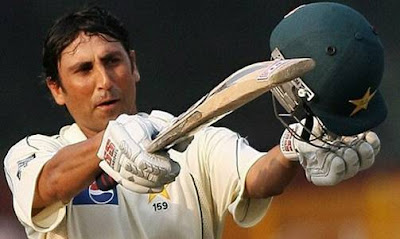
Younis Khan

Younis Khan Biography

Source(google.com.pk)
Full name Mohammad Younis Khan

Born November 29, 1977, Mardan, North-West Frontier Province

Major teams Pakistan, Habib Bank Limited, Nottinghamshire, Peshawar Cricket Association, Rajasthan Royals, South Australia, Surrey, Warwickshire, Yorkshire

Also known as Younus Khan

Playing role Middle-order batsman

Batting style Right-hand bat

Bowling style Right-arm medium, Legbreak


Younis Khan is fearless, as befits his Pathan ancestry and will forever be remembered as the second Khan to bring home a world title for Pakistan: Younis was Pakistan's captain in the 2009 World Twenty20, leading a successful campaign with stark similarities to the one Imran Khan had led 17 years earlier. Younis retired from the format straight after, a graceful and dignified gesture from a complex but honest man.


It is as a batsman, and a fearless one, that he made his name first, playing with a flourish. He is especially strong in the arc from backward point to extra cover. He is prone to getting down on one knee and driving extravagantly. But this flamboyance is coupled with grit.


Though Younis was one of the few batsmen who retained his place in the team after Pakistan's disastrous World Cup campaign in 2003, he lost it soon after due to a string of poor scores in the home series against Bangladesh and South Africa. He came back for the one-day series against India, but failed to cement a place in the Test side. He is among the better fielders in Pakistan and he took a world-record four catches in one innings as substitute during Pakistan's demolition of Bangladesh in the 2001-02 Asian Test Championship.


But until his return to the side in October 2004, he wasn't a fixture. At the pivotal one-down, against Sri Lanka in Karachi, a century laid the groundwork for his emergence as a force in Pakistan cricket. He was the top run-getter in the disastrous 3-0 whitewash in Australia immediately after and on the tour of India, for which Younis was elevated to vice-captain, he blossomed. After a horror start to the series he came back strongly, capping things off with a match-winning 267 in the final Test. He credits the late Bob Woolmer, to whom he was close, for the turnaround in his career.


Since then, barring minor troughs such as the 2005-06 series against England at home, his career has been one elongated peak, scoring hundreds against India and England for fun and becoming Pakistan's most successful one-down in recent memory. More importantly, the tour to India also showcased his potential as a future captain of Pakistan and his energetic and astute leadership has impressed many people. As captain in Inzamam's absence he led the side to a disastrous loss against the West Indies in 2005 but also to a memorable win against India in Karachi in January 2006.


He blotted his book by suddenly resigning from the captaincy in Inzamam's absence for the Champions Trophy 2006, only to return a day later and lead a scandal-afflicted side to a disappointing first round exit. He was the favourite to take over the captaincy after Pakistan's ignominous World Cup ouster in 2007 but he turned it down, citing mental strain and decided to honour his commitment with Yorkshire by making himself unavailable for Pakistan. In January 2009, however, the PCB came calling a third time, after Pakistan's disastrous home ODI series against Sri Lanka, and appointed him captain in place of Shoaib Malik. Within a few months, with the Twenty20 win, Younis was looking a natural leader.


But the peace, once again, did not last long and several senior players in the team expressed misgivings over Younis' leadership. Things came to a head against New Zealand in Sharjah, after which he announced his resignation from the top-job and sought a break from the team for the tour down under. He was included in the ODI team, midway through a disastrous tour, but struggled for form and runs. His career hit its biggest controversy in March 2010 when, along with Mohammad Yousuf, he was banned by the PCB from all Pakistan teams, for causing infighting within the team, in effect ending his career.

Younis Khan

Younis Khan

Younis Khan

Younis Khan

Younis Khan

Younis Khan

Younis Khan

Younis Khan

Younis Khan

Younis Khan

Younis Khan

Kamran Akmal

Kamran Akmal Biography

Source(google.com.pk)
Kamran Akmal (born 13 January 1982 in Lahore) is a Pakistani cricketer who has played 38 Test matches and 88 ODIs for Pakistan. He is a quick-scoring batsman and a wicket-keeper, who has achieved four centuries and two fifties in 31 Test innings. However, his first century was vital – his 109 from the number eight position at Mohali, coming in with Pakistan in a lead of 39 against India in the first Test, ensured that the visitors could draw the match. His form against the touring English in 2005 made him one of the most important players in the team. Naturally, he is a batsman that plays lower down the order but has sometimes opened in both Test and One-day cricket. As an opener he has scored two back to back centuries in ODIs against England. Coming in lower down the order in Test matches, he played one memorable innings. He saved Pakistan from a score of 39/6, scoring a century, to a competitive 245 which helped Pakistan win the match and series. His batting was highly productive in early 2006 as he scored seven international hundreds within the space of 6 months. Since his tour of England in Summer 2006 however his batting form dwindled and steadily become worse. His wicket-keeping also worsened and dropped many catches on both the England tour and on a tour to South Africa in early 2007. Since then he did not score an international hundred until the Bangladeshi tour of Pakistan in 2008. Kamran Akmal was dropped for the Asia Cup 2008 as a result of his poor batting form and very poor keeping. He was replaced by Sarfraz Ahmed who has performed very well the domestic level. Kamran was named in the 30 man probable squad for the 2008 ICC Champions Trophy. On 12 November 2008, Akmal hit two consecutive 6s in the last over. As a result Pakistan won the first ODI in Abu Dhabi against West Indies. Akmal was also signed on to the Rajasthan Royals, and played in the inaugural season of the IPL. He played five matches in the tournament, as wicket-keeper and top-order batsman, including the final of the tournament against the Chennai Super Kings. He took two catches in the first innings, however he was run out for six runs during the Royal’s chase. The Royals went on to win the tournament after a thrilling finish.
Akmal is a quick-scoring batsman and a wicket-keeper, who has achieved 6 centuries in Test innings. However, his first century was vital – his 109 from the number eight position at Mohali, coming in with Pakistan in a lead of 39 against India in the first Test, ensured that the visitors could draw the match. His form against the touring English in 2005 made him one of the most important players in the team. Naturally, he is a batsman that plays lower down the order but has sometimes opened in both Test and One-day cricket. As an opener he has scored two back to back centuries in ODIs against England. Coming in lower down the order in Test matches, he played one memorable innings. He saved Pakistan from a score of 39/6, scoring a century, to a competitive 245 which helped Pakistan win the match and the series.
His batting was highly productive in early 2006 as he scored seven international hundreds within the space of 6 months. Since his tour of England in Summer 2006 however his batting form dwindled and steadily become worse. His wicket-keeping also worsened and dropped many catches on both the England tour and on a tour to South Africa in early 2007. He then scored an international hundred in the Bangladeshi tour of Pakistan in 2008. He later moved to have some injuries and did not play for some days but later he was again brought into the team.
Akmal was dropped for the Asia Cup 2008 as a result of his poor wicket-keeping. He was replaced by Sarfraz Ahmed who performed very well at the domestic level and also because of Sarfraz's strong showing in the U-19 World Cup. Akmal was named in the 30 man probable squad for the 2008 ICC Champions Trophy.
Akmal was part of the Pakistan team that won the T20 World Cup in 2009. He was notable for his quick stumpings, dismissing 4 batsmen in one match against Netherlands.
On 12 November 2008, Akmal hit two consecutive 6s in the last over. As a result Pakistan won the first ODI in Abu Dhabi against West Indies.
On 17 July 2010, Akmal was appointed the vice-captain of the Pakistani test squad but later removed because of his alleged involvement in spot fixing.[3]
In August 2012, Akmal was recalled for the three ODI series against Australia.[4]

Kamran Akmal

Kamran Akmal

Kamran Akmal

Kamran Akmal

Kamran Akmal

Kamran Akmal

Kamran Akmal

Kamran Akmal

Kamran Akmal

Kamran Akmal

Kamran Akmal

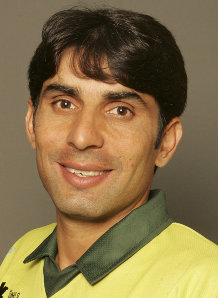
Misbah-ul-Haq

Misbah-ul-Haq Biography

Source(google.com.pk)
Misbah ul Haq, Cricketers is famous for Cricket, Pakistani celebrity. Born on 28 May, 1974

Misbah-ul-Haq Khan Niazi is a Pakistani cricketer and the captain of the Pakistan national cricket team for Tests and ODIs.

Early career
Misbah was initially noticed for his technique and his temperament in the Tri-nation tournament in Nairobi, Kenya in 2002, as he scored two fifties in the three innings in which he played, however, over the next three Tests he played against Australia, he failed to score more than twenty runs and was soon dumped from the team. Having witnessed Pakistan being eliminated in the opening phase of the 2003 Cricket World Cup, Misbah was part of the changes made to the team in the aftermath of these results, but failed to make much of an impact and was soon dropped again.

Comeback
At the age of 33, Misbah was chosen to play in the inaugural ICC World Twenty20 in 2007, filling the middle order spot vacated by Inzamam-ul-Haq. He had been regularly making runs in Pakistani domestic cricket and in the years before his recall he was consistently one of the top run scorers at each season's end, with his first-class average briefly climbing above 50.

Misbah was one of the stars of the tournament, playing a large part in many thrilling run chases. The first was in the group stage against India where he scored a half century in a tied match. He was run out attempting the winning run off the last ball of the match. In their Super 8s encounter with Australia he was named Man of the Match with an unbeaten 66 off 42 deliveries to see his side home with 5 balls to spare. Another unbeaten innings in the semi final against New Zealand saw Pakistan book a spot in the final against India.

He played an instrumental role in Pakistan's recovery in the inaugural 2007 ICC World Twenty20 final against arch-rivals India, with three sixes. He hit the first legitimate ball of the last over for six. With 6 runs needed to win off 4 remaining balls, Misbah tried to scoop the ball over short fine leg, but was caught out by Sreesanth. He repeated for the 3rd time against India in the semi final of the 2011 World Cup where India won by 29 runs.

Misbah scored his maiden Test hundred against India at Kolkata in the 2nd Test of the 2007 series. After India managed 616 in their first innings, Pakistan were at 5 for 150 in reply and in danger of following on when Misbah and Kamran Akmal put together a match saving 207 run stand. Misbah finished on 161 not out. In the 3rd & final Test of the series, Misbah made another fluent century this time finishing on 133 not out.

2008 began with some high points for Misbah as he was elevated to the post of Vice - Captain of the Pakistan team and was awarded a Grade A Contract. Since returning to International Cricket for Pakistan, Misbah has gone through a sustained patch of prolific run scoring. In his last 5 Test Match innings for Pakistan, he has notched up 458 runs at a very high batting average of 152.67 against India. In his last 5 ODIs as well, Misbah has made 190 Runs at an average of 63.33 & in Domestic Cricket for Punjab, he has amassed an astounding 586 runs at an average of 195.33 with 2 centuries and his highest first-class score of 208*.

Dropping out and the captaincy (2010-2011)
Misbah was dropped from the team after the 2010 ICC World Twenty20 and missed the team's controversial tour of England in August 2010 Due to the batting-collapses that Pakistan suffered during that tour Misbah was recalled for the subsequent tour against South Africa in the UAE to lead as a captain of the team for test series. Many people expressed there surprise at the appointment of Misbah as captain. Wasim Akram stated that although the decision was surprising if Misbah bats and fields well everything else will go according to plan. Former Pakistan coach Geoff Lawson stated that he believed Misbah has the best cricketing brain within Pakistan and he will do incredibly well in the plans for the captaincy Misbah hit back at those who criticised the decision to appoint him captain and stated that he should be given a chance to prove himself In his first match as test captain he set an example for his team when he scored 71* in a 168 run partnership with Younus Khan this helped Pakistan salvage a draw from the match

Two-test series in New Zealand (2011)
After Three Twenty20's in which Misbah did not play as Pakistan lost the series 2-1. He returned to captaining the test side and during his third test as captain he claimed his first victory when Pakistan beat New Zealand by 10 wickets. New Zealand were bowled out for 275 and during Pakistan's first innings Misbah reached a half-century before being trapped in front on 62, however Asad Shafiq top-scored in the innings with 83. Pakistan took a slender lead of 92 and bowled New Zealand out for 110 needing just 19 runs for victory and Pakistan sealed a crushing win when Taufeeq Umar sealed the winning run as Pakistan won by ten wickets and took a 1-0 lead in the series. The following match Misbah stated that the team's main focus was on improving themselves and that winning the series was a side focus. In the second and final Test of th series, Misbah yet again impressed with the bat. He was trapped in front just one short of a century in the first innings, with Pakistan taking a slender first innings lead. New Zealand posted 293 in their 2nd innings leaving Pakistan needing 274 to win on the findal day. An opening barrage from New Zealand's seamers left Pakistan struggling at 42-3, with Misbah joining Younis Khan at the crease. The two put on 118 runs and Misbah remained undefeated as Pakistan held out for a draw, finishing 226-5. This secured Pakistan's first Test series win since 2007 and helped raise Misbah's average as Captain to 112.75.

Misbah-ul-Haq

Misbah-ul-Haq

Misbah-ul-Haq

Misbah-ul-Haq

Misbah-ul-Haq

Misbah-ul-Haq

Misbah-ul-Haq

Misbah-ul-Haq

Misbah-ul-Haq

Misbah-ul-Haq

Misbah-ul-Haq 

Muhammad Hafeez

Muhammad Hafeez Biography

Source(google.com.pk)
Mohammad Hafeez, Cricketers is famous for Cricket, Pakistani celebrity. Born on 17 October, 1980

Mohammad Hafeez is a Pakistani cricketer. He is a right-handed batsman and a right-arm offbreak bowler. Hafeez generally opens the batting and is also skilful boundary fielder.

International career
Hafeez was one of the several young all-rounders the Pakistani cricket team turned to after their poor Cricket World Cup display in 2003, in which they were eliminated in the first round.

Hafeez scored a half-century on his Test debut against Bangladesh, and in his following Test hit a century. His form with bat and ball would then drop considerably and in late-2003 he was dropped from the Test squad, and soon after the ODI side. With strong domestic performances as well as good showings for the Pakistan A, he remained on the fringes of a recall in 2004. Hafeez returned to the ODI side in 2005 and despite not contributing with the bat, his bowling performances were impressive. In the 2006 Top End Series held in Australia, Hafeez smashed a century for Pakistan A. With Pakistan struggling to find a solid opening pair for Test cricket, Hafeez was recalled for the tour of England. His return to Test cricket was made at The Oval and he scored a fluent 95. Later that year in November, Hafeez retained his place in the side for their home series against the West Indies. After getting starts in the first two Test he would go on to score his 2nd Test century in the 3rd Test in Karachi.

2010 Recall and Good Form
In 2010 he was recalled for the 3rd ICC World T20 Cup. he had poor form in it but showed signs of class batting. He was subsequently recalled again for the T20Is and the ODIs on Pakistan's tour of England. He had some good scores in it and had some solid partnerships with opener Kamran Akmal.

Following this good form he was also in the squad that was selected to play South Africa in the UAE. After some impressive score in the opener slot, he was again rewarded with now a test call up. He had some decent scores in the test matches and bowled some tidy overs of offspin as well.

At the end of 2010 he was also selected for the party that would tour New Zealand. In all of the T20s he made some good scores including a 46.

In the ICC Cricket World Cup 2011, he started the tournament with a few poor scores with the bat, and was consistent with the ball. Especially 10 overs for just 26 runs against Australia and 2 wickets for 16 runs in quarter final. In the quarter-final against West Indies, Hafeez provided a major contribution to the team's victory with 2 wickets and 60*, receiving the player of the match award. Also in the semi final he scored 43 runs and took a wicket for 31 runs in 10 overs although Pakistan lost the match.

In the tour of the West Indies, Hafeez continued his good form with both bat and ball scoring 267 runs in 5 matches with an average of 53.40, and took 6 wickets at an average of 23.50. . He made his second One Day International century in the 4th ODI, where he scored 121 runs before being bowled by the promising leg spinner Devendra Bishoo.
Mohammad Hafeez (born 17 October 1980) is a Pakistani cricket player. He is currently the captain of Pakistan in the T20 format. He is a right-hand opening batsman and a right-arm offspin bowler. Hafeez usually opens the batting and forms part of bowling attack. In 2012/2013 he has been ranked as the top all-rounder according to the ICC Player Rankings in T20 format. He is known for his intelligent batting but also aggressive shot plays when needed.[2]
He was the fourth international player signed to the Caribbean Premier League and the first Pakistani player to be named to the new Twenty20 tournament.[3]
Contents  [hide]
1 Early international career 2003 – 2006
2 International recall 2010
3 Appointed T20 captain
4 Test centuries
5 One Day International centuries
6 References
7 External links
Early international career 2003 – 2006[edit]

Mohammad Hafeez Cheena was one of several young all-rounders that the Pakistani cricket team turned to in order to revitalise their side after their poor display in 2003 World Cup following their elimination in the first round. His form with both bat and ball was inconsistent and in late-2003 he was dropped from the Test squad and subsequently the ODI side. Following strong domestic performances, as well as displaying good form for the Pakistan A side, he remained on the fringes of a recall in 2004.
Hafeez returned to the ODI side in 2005 and despite poor form with the bat, his bowling performances were impressive. In the 2006 series held in Australia, Hafeez smashed his first century for Pakistan. With Pakistan struggling to find a solid opening pair for the Test side, he was recalled for the tour of England. His return to Test cricket was made at The Oval where he scored a fluent 95. Subsequently Hafeez retained his place in the side for their home series against the West Indies in November of that year. After getting out early after good starts in the first two Tests he went on to score his second Test century in the third Test in Karachi. However his form remained inconsistent and he was unable to command a regular place in either the Test or ODI side over the next 5 years.
International recall 2010[edit]

In 2010 he was recalled for the third ICC World Twenty20 squad. His form was poor scoring only 39 runs and taking only 2 wickets in 6 matches. However he was subsequently selected for the T20Is and the ODIs on Pakistan's 2010 tour of England. He was the second highest Pakistani run scorer in the ODI series producing some solid opening partnerships with Kamran Akmal. Following this good form he was included in the squad that was selected to play South Africa in the UAE and he replaced disgraced skipper Salman Butt as an opening batsman in both Tests, achieving a batting average 32.50. He played in all 5 ODI matches ending up as the top run scorer and he also topped the bowling averages for the series. At the end of 2010 he was also selected for the party that would tour New Zealand and the West Indies and this resulted in him establishing himself as a regular in the Test, ODI and T20 teams. In 2011 he won an amazing 10 Man-of-the-Match awards in all forms of international cricket and became only the third player (after Sanath Jayasuriya and Jacques Kallis) to score 1000 runs and take 30 wickets in ODI matches within a calendar year.
Against India on 18 March 2012 in Bangladesh at Shere Bangla National Stadium, Mirpur at the 2012 Asia Cup, he scored 105 off 113 balls and was involved in a 224 run partnership with Nasir Jamshed, which is the best opening partnership for Pakistan against India in one day internationals. They eclipsed Aamer Sohail and Saeed Anwar's record of 144 runs which was made in 1996.[4] He made his 4th ODI century in March 2012 against Bangladesh at Dhaka. He also made his highest test score of 196 against Sri Lanka in the second Test at Colombo in June 2012. He is currently (2012) ranked number two in the ICC ODI rankings for both bowlers and all-rounders.

Muhammad Hafeez

Muhammad Hafeez

Muhammad Hafeez

Muhammad Hafeez

Muhammad Hafeez

Muhammad Hafeez

Muhammad Hafeez

Muhammad Hafeez

Muhammad Hafeez

Muhammad Hafeez

Muhammad Hafeez